Pages

Monday, May 12, 2014

Philippine History today: May 13


1903 - Apolinario Mabini died of Cholera. Apolinario Mabini y Maranan was a Filipino revolutionary and lawyer who served as its first prime minister until May 1899. In Philippine history texts, he is often referred to as "the Sublime Paralytic", and as "the Brains of the Revolution." To his enemies and detractors, he is referred to as the "Dark Chamber of the President."

Mabini was most active in the Revolution in 1898, when he served as the chief adviser for General Emilio Aguinaldo. He became the president of the Cabinet and secretary of Foreign Affairs. He wrote most of the decrees of the revolutionary government and prepared a constitutional program wherein he proposed a Constitution for the Philippines.

Mabini found himself in the center of the most critical period in the new country's history, grappling with problems until then unimagined. Most notable of these were his negotiations with Americans, which began on March 6, 1899. The United States and the Philippine Republic were embroiled in extremely contentious and eventually violent confrontations. During the negotiations for peace, Americans proffered Mabini autonomy for Aguinaldo's new government, but the talks failed because Mabini’s conditions included a ceasefire, which was rejected. Mabini negotiated once again, seeking for an armistice instead, but the talks failed yet again. Eventually, feeling that the Americans were not negotiating 'bona fide,' he forswore the Americans and supported war. He resigned from government on May 7, 1899.

On December 10, 1899, during the Philippine-American war, he was captured by Americans at Cuyapo, Nueva Ecija, but was later set free. In 1901, he was exiled to Guam, along with scores of revolutionists the Americans referred to as "insurrectos" and who refused to swear fealty to imperialist America.

Mabini returned home to the Philippines in Feb. 1903 after agreeing to take the oath of allegiance to the United States on February 26, 1903 before the Collector of Customs. On the day he sailed, he issued this statement to the press:

To the chagrin of the American colonial officials, however, Mabini resumed his work of agitating for independence for the Philippines soon after he was back home from exile.  On May 13, 1903 Mabini died of cholera in Manila, at the age of 39.[


Monday, April 14, 2014

Philippine History - April 14

It's the first influence of the powerful Catholic church in the Philippine where 500 were baptized in the name of the Church led by three Raja - Humabon, Homonhon and Kolambu. Just a week after Magellan's arrival, the three Raja led their people to be baptized in a strange belief that they don't understand. From that moment on, the Catholic Church will have a role in Philippine politics.

Thursday, April 10, 2014

Philippine History: April 11

Secretary of State John Milton Hay signs the Treaty of Paris


Philippine History today, April 11: Treaty of Paris - the Spanish Empire's surrender of control of Cuba and ceding Puerto Rico, parts of the Spanish West Indies, the island of Guam, and the Philippines to the United States of America. The ceding of the Philippines was ratified on April 11, 1899 that involved payment of $20,000,000 and it was handed over by no other than Secretary of State John Milton Hay. The Spanish Empire needed the money in their war against Britain. The ceding followed a mock battle with the Spanish government sacrificing their remaining soldiers in the country in the process. Americans were hailed as victors and after the Spaniards' defeat, began their take over.

During the negotiations, Spanish negotiators were determined to hang onto all they could, hoping to cede only Mindanao and perhaps the Sulu Islands. On the American side, Chairman Day had once recommended the acquisition of only naval base in Manila as a "hitching post". Others had recommended retaining just the island of Luzon. In discussions with its advisers, though, the commission concluded that Spain, if it retained part of the Philippines, would be likely to sell that part to another European power and that this would likely be troublesome for America. On November 25, the American Commission cabled President McKinley for explicit instructions. Their cable crossed one from McKinley saying that duty left him no choice but to demand the entire archipelago, the following morning, another cable from McKinley arrived, saying

... to accept merely Luzon, leaving the rest of the islands subject to Spanish rule, or to be the subject of future contention, cannot be justified on political, commercial, or humanitarian grounds. The cessation must be the whole archipelago or none. The latter is wholly inadmissible, and the former must therefore be required.
On November 4, the Spanish delegation formally accepted the American demand, and Spain's Prime Minister, Práxedes Mateo Sagasta, backed up the commission. As the specter of collapse of the negotiations grew, there were mutters about resumption of the war. U.S. election results on November 8, however, cut McKinley's Republican majority in Congress less than had been anticipated. The American delegation took heart from this, and Frye unveiled a plan of offering Spain ten or twenty million dollars for the islands.

After some discussion the American delegation offered twenty million dollars on November 21, one tenth of a valuation which had been estimated in internal discussions in October, requesting an answer within two days. Rios said angrily that he could reply at once, but the American delegation had already departed from the conference table. When the two sides met again, Queen-Regent Maria Christina had cabled her acceptance. Montero Rios recited the formal reply:

The Government of Her Majesty, moved by lofty reasons of patriotism and humanity, will not assume the responsibility of again bringing upon Spain all the horrors of war. In order to avoid them, it resigns itself to the painful task of submitting to the law of the victor, however harsh it may be, and as Spain lacks the material means to defend the rights she believes hers, having recorded them, she accepts the only terms the United States offers her for the concluding of the treaty of peace.

Work on the final draft of the treaty began on November 30. It was signed on December 10, 1898. The next step was legislative ratification. In Madrid, the Cortes rejected it, but the Queen Regent signed it, empowered to do so by a clause in the Spanish constitution.

Saturday, January 11, 2014

Philippine History - January 12

Photo from - http://tripwow.tripadvisor.com/slideshow-photo/he-received-a-bad-letter-from-silvestre-ubaldo-madrid-spain.html?sid=132099514&fid=upload_13809636704-tpfil02bw-1308


On January 12, 1889, Hispano-Filipino Association
, an organization composed of Filipinos and Spaniards, was formed in Madrid, Spain calling for reforms in the Philippines during Spanish colonization.

Among other things, it campaigned for Philippine representation in the Spanish Cortes and the passage of the Maura Law to bring about educational reforms in the archipelago. 

The association was formed as reformists realized that putting up an organization would mean pooling of their resources and efforts in the campaign to have their voices heard by Spanish (pensular) government.

The organization was formed to included Spaniards sympathetic to the plight of the Filipinos in the Colonial Philippines. It was formed a month after the La Solidaridad, all Filipino organization Composed of Filipino liberals exiled in 1872 and students attending Europe's universities was organized on December 13, 1888. (The organization will later produce a newspaper of the same name published in Barcelona, Spain on February 15, 1889.)

Filipino members of the Hispano-Filipino Associacion includes Graciano Lopez Jaena, Marcelo H. del Pilar, Mariano Ponce, Jose M. Panganiban, Eduardo de Lete, and a few others. 

The Spanish members of the society were Miguel Morayta, professor of history at the Universidad Central de Madrid, and Felipe de la Corte, author of several works on the Philippines. Miguel Morayta is said to be the one who started the assosacion. 

Society was divided into three sections to make the propaganda effective -- political section under Del Pilar; literary section under Ponce; and the sports section under Arejola.

However, intensive campaign for reforms did not yield any tangible results in the form of changes in the administration of the Philippines because Spain was too preoccupied with its own internal problems to give moment’s thought to colonial problem; friars were too powerful even in Spain to be sidetracked by the Spanish authorities.

The association lobbied successfully for the passage of some laws which included the law pertaining to the compulsory teaching of Spanish and the laws providing reforms in the judiciary. However, these laws were not fully implemented considering the return to power of the reactionary group in Spain. 

Since the membership of the asociation was composed mostly of Spaniards, it failed to secure the support many Filipinos including Dr. Jose Rizal and Antonio Luna. The young Filipinos felt that the Spaniards and the creoles were too moderate in dealing with their clamor for reforms.

Source: Philippine History by M. C. Halili

Philippines: January 11

On January 11, 1897 in Bagumbayan, on or around the same place where Jose Rizal fell dead 12 days earlier, 13 martyrs were executed and they were known in history as the 13 martyrs of Bagumbayan. 

Photo from http://www.freewebs.com/philippineamericanwar/background.htm


Who they were or what they did is not known to many of us. Here are some info of who they are.
  1. Domingo Franco, a tobacco merchant, was originally from Capiz but moved to Manila. One of the founding members of Liga Filipina, he knew Jose Rizal and was said to have distributed "Noli me tangere" and "El Filibusterismo" when it was dangerous to read or even own a copy. He helped raise money to send to the so-called Propaganda Movement in Spain and for these, he was arrested, tortured, and eventually executed.
  2. Numerio Adriano (1846-1897) was a lawyer and a Mason. He knew Rizal and Apolinario Mabini. Being a founding member of Liga Filipina, he was also implicated in the Katipunan.
  3. Moises Salvador (1868-1897) studied at the Ateneo Municipal and took further studies in Madrid. He knew Rizal and was a Mason and a member of Liga Filipina -- just the right mix to be included in the group executed in early 1897.
  4. Francisco L. Roxas (1851-1897) was a musician and businessman. He would probably be better known today had his musical compositions survived, but his life was cut short when he was implicated in the Katipunan revolt. He protested this and maintained his innocence, but since his name was on a list found by the authorities, he became a reluctant hero and joined the Thirteen Martyrs of Bagumbayan.
  5. Jose Dizon was an engraver in Casa de Moneda in Manila. He was involved in the Katipunan, having joined a group that met sympathetic Japanese for the procurement of arms for the revolution. Like all the other members of the Thirteen Martyrs, he too was a Mason.
  6. Benedicto Nijaga, a second lieutenant in the Spanish army, was reputedly a good soldier. But his loyalty became suspect when he was connected to the Katipunan revolt. We do not know whether his name was on a list of Katipuneros found during the raid of the printing shop of Diario de Manila, or whether he was implicated by an enemy or somebody who had been tortured.
  7. Cristobal Medina was a Filipino corporal in the Spanish army, yet his loyalty remained with his country and his countrymen so he joined the Katipunan and was supposed to have helped plan the uprising in San Juan del Monte on Aug. 30, 1896. For this act, real or imagined, he was implicated.
  8. Antonio Salazar was a businessman originally from Cavite and owned Bazaar El Cisne. It was from his confession, extracted by torture, that others were implicated in the Katipunan, particularly Domingo Franco.
  9. Ramon A. Padilla, an employee of the Manila customs house, was rude to Emilio Aguinaldo, who nursed a grudge against him that almost led to a duel. He later apologized to Aguinaldo and this probably saved his life for the moment, but only until Jan. 11, 1897.
  10. Faustino Villaruel (1841-1897) was a merchant from Pandacan and a Mason like all the others. He was also a founding member of Liga Filipina, and supporter of the Propaganda Movement.
  11. Braulio Rivera (1867-1897) was also a member of the Katipunan.
  12. Luis Enciso Villareal (1846-1897) was originally from Daraga, Albay, and was known for his graceful dancing and fiddle playing. He read a French manual on tailoring and opened a shop on Escolta Street, where he conducted brisk business. He won the lottery and traveled in Japan. He was probably implicated with the Katipunan because he was a Mason and a member of Liga Filipina, and contributed to the Propaganda Movement.
  13. Eustacio Manalac is the person we know so little about. Nobody has done even basic research to find out his date of birth and simple biographical data like marital status, children, occupation, etc. All we are told is that he was a Mason rounded up as a suspected Katipunero when the Katipunan was exposed in August 1896.
Source of the above info is from http://globalnation.inquirer.net/mindfeeds/mindfeeds/view/20070115-43488/Who_were_the_Thirteen_Martyrs%3F

Friday, September 10, 2010

Philippines: September 10

The Widow

Exactly 247 years ago today, bravery of Filipinos is being written in history as a revolutinary leader challenges a powerful conqueror/nation in a historic battle. And these revolutionaries with Ilocano and Tinguian warriors were led not by a General but a woman, a widow named Gabriela Silang. Few days after the battle, Gabriela was executed but her legacy lived on.

Born in Barangay Caniogan, Santa, Ilocos Sur, Silang was a mestiza, of Spanish and Ilocano descent. In 1757, she married a 27-year-old Ilocano insurgent leader, Diego Silang. She became one of his closest advisors, a major figure in her husband's collaboration with the British and the brief expulsion of Spanish officials from Vigan, Ilocos Sur during the British occupation of the Philippines.

After her husband was assassinated by order of royal and church authorities in Manilaon May 28, 1763, Gabriela fled on horseback to the mountains of Abra to establish her headquarters, reassemble her troops, and rally the Tingguian community to fight. They descended on Vigan on September 10, 1763. But the garrison was ready, amassing Spanish, Tagalog, and Kapampangan soldiers, and Ilocano collaborators to ambush her and rout her forces. Many were killed. She escaped, alongside her uncle Nicolás and seven others, but later caught on September 29, 1763. They were summarily hanged in Vigan's plaza, with Gabriela being the last to die.

Her complete name is María Josefa Gabriela Cariño Silang.

Friday, April 9, 2010

Philippines: April 9

The Bataan Death March (also known as The Death March of Bataan) (Batān Shi no Kōshin バターン死の行進)


 April 9, 1942 was not just an important moment in the Philippines but in the history of humankind. If the Germans were the infamous villains in Europe, in Asia are the Japanese. After the Japanese army’s successful raid in Hawaii on December 7, 1941, they turned their forces to the American controlled Philippines. For three months, the joint Filipino American forces defended Bataan. They have fought bravely until their supplies were exhausted.

At dawn on 9 April, and against the orders of Generals Douglas MacArthur and Jonathan Wainwright, Major General Edward P. King, Jr., commanding Luzon Force, Bataan, Philippine Islands, surrendered more than 75,000 (67,000 Filipinos, 1,000 Chinese Filipinos, and 11,796 Americans) starving and disease-ridden men. He inquired of Colonel Motoo Nakayama, the Japanese colonel to whom he tendered his pistol in lieu of his lost sword, whether the Americans and Filipinos would be well treated. The Japanese aide-de-camp replied: “We are not barbarians.”

The prisoners of war were immediately robbed of their keepsakes and belongings and what follows is one of the most inhumane incidents in human history.
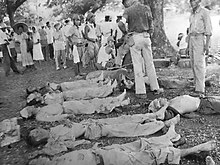
The 75,000 prisoners of war forced to endure a 61-mile (98 km) march in deep dust, over vehicle-broken macadam roads, and crammed into rail cars to captivity at Camp O’Donnell in Tarlac. Thousands died en route from disease, starvation, dehydration, heat prostration, untreated wounds, and wanton execution.
Those few who were lucky enough to travel to San Fernando on trucks still had to endure more than 25 miles of marching.

Physical abuse and murder resulted in very high fatalities inflicted upon the prisoners and civilians along the route by the armed forces of the Empire of Japan. Beheadings, cutting of throats and casual shootings were the more common actions—compared to instances of bayonet stabbing, rape, disembowelment, rifle butt beating and a deliberate refusal to allow the prisoners food or water while keeping them continually marching for nearly a week in tropical heat. Falling down or inability to continue moving was tantamount to a death sentence, as was any degree of protest or expression of displeasure.

Prisoners were attacked for assisting someone falling due to weakness, or for no apparent reason whatsoever. Strings of Japanese trucks were known to drive over anyone who fell. Riders in vehicles would casually stick out a rifle bayonet and cut a string of throats in the lines of men marching alongside the road. Accounts of being forcibly marched for five to six days with no food and a single sip of water are in postwar archives including filmed reports.

The exact death count has been impossible to determine as thousands of captives were able to escape from their guards, but some historians have placed the minimum death toll between six and eleven thousand men; whereas other postwar Allied reports have tabulated that only 54,000 of the 75,000 prisoners reached their destination—taken together, the figures document a casual killing rate of one in four up to two in seven (25% to 28.6%) of those brutalized by the forcible march. The number of deaths that took place in the internment camps from delayed effects of the march is uncertain, but believed to be high. All told, approximately 5,000–10,000 Filipino and 600–650 American prisoners of war died before they could reach Camp O'Donnell.

After the surrender of Japan in 1945, an Allied commission convicted Masaharu Homma of war crimes, including the atrocities of the death march out of Bataan, and the following atrocities at Camp O'Donnell and Cabanatuan. He was executed on April 3, 1946 outside Manila.

Wednesday, April 7, 2010

Philippines: April 7


After arriving to Samar on March 16, 1521, Magellan decided to explore more of the islands that will later become the Philippines. On April 7, 1521 Magellan reached Cebu and meet with Rajah Humabon. The two performed a sacred tradition of the native people called the blood compact as part of the tribal tradition to seal their friendship and treaty.

Seven days later,Rajah Jumabon and 500 of his men were baptized as the first Christians (Catholics) in the Philippines. Humabon was named Carlos in honour of king Charles I of Spain, while his principal wife Hara Amihan was named Juana, after king Charles' mother, Johanna.

According to Antonio Pigafetta, a Venetian scholar born in Vicenza who was traveling with Magellan, it was Humabon who had requested Magellan to kill his rival Datu Lapu Lapu, the Datu (chieftain) of nearby Mactan island. Humabon's conversion to Christianity however, had an adverse affect of allowing the Spaniards to control Humabon and his people. After quarrel and mis-understanding erupted between the Spaniards and the Cebuanos, Rajah Humabon and his warriors plotted to poison the remaining Spanish soldiers in Cebu after the death of Magellan at the Battle of Mactan.


On April 7, 1976, the Philippines Arts Center was inaugurated in Mt. Makiling, Laguna by First Lady Imelda Marcos as a haven for young and aspiring artists. Its various buildings and facilities are scattered over 13.5 hectares of the Makiling Forest Reservation and also houses the Philippine High School for the Arts, a government-run secondary educational institution for gifted young artists.

Monday, April 5, 2010

Philippines: April 6

On April 6, 1924, the first Balagtasan was held in Manila between Jose Corazon de Jesus and Florante T. Collantes. They are both from Bulacan.


José Corazón de Jesús, also known by his pen name Huseng Batute, was a Filipino poet who used Tagalog poetry to express the Filipinos' desire for independence specially during the American occupation of the Philippines, a period that lasted from 1901 to 1946. He is best known for being the lyricist of the Filipino song Bayan Ko.

On March 28, 1924, De Jesús and other leading Tagalog writers met at Instituto de Mujeres (Women's Institute)in Tondo, Manila to discuss how to celebrate the birth anniversary of Tagalog poet Francisco Balagtas on April 2. They decided to hold a traditional duplo, or a dramatic debate in verse that was in its waning days in the 1920s. They changed the format of the duplo and renamed it balagtasan in honor of Balagtas.

There were three pairs of poets who participated in the first balagtasan on April 6, 1924 at the institution, but the audience were most impressed by De Jesús and another Filipino poet, Florentino Collantes.

The balagtasan was an instant hit and it later became a common feature in Manila's biggest and most expensive theaters until the 1950s. De Jesus and Collantes were pitted against each other in a contrived rivalry and a showdown was set for Oct. 18, 1925 at the Olympic Stadium. De Jesús was acclaimed winner of the showdown and was dubbed "Hari ng Balagtasan" (king of versified debate). He held the title until his death in 1932.

Tuesday, February 23, 2010

Philippines: February 23

On February 22, 1986, Defense Secretary Juan Ponce Enrile and Vice Chief of Staff Fidel V. Ramos breaks from Marcos and secured Camp Aguinaldo and draw People Power Support. The next day, about 2 million civilians ringed Camps Aguinaldo and Crame against Marcos Force. It was known as the EDSA revolution that toppled the 20-year reign of Ferdinand Marcos in the Philippines.


EDSA Revolution

The event astonished even the international community that it became headlines to major newspapers and magazines. It was the inspiration for subsequent non-violent demonstration around the world. One of the most significant part of the Philippine History.

Death of the Tiger

Forty years before the EDSA revolution, another significant history happened in Los Banos. The great General Tomoyuki Yamashita, also known as the Tiger of Malaya, the defender of the Philippines against America was hanged for war crimes.

On December 8,1941, General Yamashita has conquered the British colonies of Malaya and Singapore, where his 30,000 front line troops captured 130,000 British, Indian and Australian troops earning the nickname "The Tiger of Malaya".

In 1944, when the war situation was critical for Japan, Yamashita assumed the command of the Fourteenth Area Army to defend the Philippines on 10 October. The U.S. Army landed on Leyte on 20 October, only ten days after Yamashita's arrival at Manila. On 6 January 1945 the Sixth U.S. Army landed at Lingayen Gulf in Luzon.

Yamashita commanded approximately 262,000 troops in three defensive groups. He was forced out of Manila and retreated to the mountains of northern Luzon.

Rear Admiral Sanji Iwabuchi was left to defend the city. He took command of the 3,750 Army security troops, and against Yamashita's specific order, turned the city into a battlefield that resulted in the deaths of more than 100,000 Filipino civilians. This would be later known as the Manila Massacre. The fierce battle happned from February 4 to March 3 in 1945.
Yamashita used delaying tactics to maintain his army in Kiangan (part of the Ifugao Province), until 2 September 1945, after the surrender of Japan, where his forces were reduced to under 50,000 by the tough campaigning by elements of the combined American and Filipino soldiers including the recognized guerrillas. Yamashita surrendered in the presence of Generals Jonathan Wainwright and Arthur Percival, both of whom had been POWs in Manchuria. Ironically, Percival had surrendered to Yamashita after the Battle of Singapore. This time, however, Percival refused to shake Yamashita's hand, being angered by the exterminationist tactics that Yamashita had allegedly employed against Allied prisoners of war, so Yamashita burst into tears. Although Yamashita might have been expected to commit suicide prior to this surrender, he reportedly explained his decision not to kill himself by saying that if he did "someone else will have to take the blame."


Ali Mudin's Treaty

More than 200 years ago, another significant History happened in Jolo. The King Ali Mudin signed a treaty with the Spaniards.

Ali Mudin was the King of Jolo and was captured by the Spaniards in their battle against the Moro in 1749. He was brought to Manila with his son Israel. Israel was allowed to study in San Jose, a school by the Spaniards. In his absence, Bantilan assumed the throne as King.

After few years with the Christians, Ali Mudin was encouraged to be baptized and was given the name Fernando 1. After a few years, the Governor Obando decided to bring Ali to his throne. He went back to Julo with the Spanish soldiers and fought the Moros. A treaty was signed between the Moro and the Spaniards.

When Ali Mudin did not go with the Spaniards to Zamboanga, they assumed that he is a traitor and he together with his 200 people were brought back to Manila. From then on, the Spaniards lead a continues battle against the Moros.

Ali Mudin asked the Spaniards to let his daughter Fatima to return to Julo and negotiate peace. In 1753, his request was granted and Fatima brought back a letter from Bantilan. He requested that Ali Mudin will return to Julo and they will sign a new treaty of peace. The released Ali but requested that he stay in Manila. He was given a home and servants.
In 1762, Manila was attacked by English forces. Ali Mudin and his 50 warriors fought the new invaders. With his brave contribution in the battle, Ali Mudin was allowed to return to Julo to battle the English forces who have camped in a nearby island. A new treaty was signed between the Ali Mudin and the Spaniards on February 23, 1763.

Ali Mudin returned and drove the English away. He continued to rule and died in his homeland.

Sunday, August 30, 2009

Philippines: August 30

On August 30, 1896 the Revolutionary action in Pinaglabanan, San Juan and Governor General Blanco proclaims a state of war in Manila, Cavite, Bulacan, Pampanga, Laguna, Batangas, Nueva Ecija and Tarlac: The eight rays of the sun on the Philippine Flag.

Sunday, August 23, 2009

Philippines, August 23


On August 23, 1896, Bonifacio lead the Katipuneros in tearing their cedulas symbolizing their determination to take up arms and fight the Spanish Colonizers. It was known as the Cry of Pugad Lawin. On August 23, 1907, the next colonizers ban the display of the Filipino Flag.

Friday, August 21, 2009

Philippines: August 21


On August 21, 1971, Marcos suspends the writ of habeas corpuz after the Plaza Miranda bombing of the Liberal Party rally killing 8. Ninoy Aquino was one of the first to be arrested and imprisoned on trumped-up charges of murder, illegal possession of firearms and subversion without the benefit of the writ of habeas corpuz.

On the same date 12 years later, he was assassinated at the tarmac of the plane at the Manila International Airport upon his return from exile.


In his speech during the funeral, Jovito Salonga called Ninoy "...The greatest president we never had ..."